Philosophy
Song
Deleuze
Wh- Do People Sing? (Part 1)
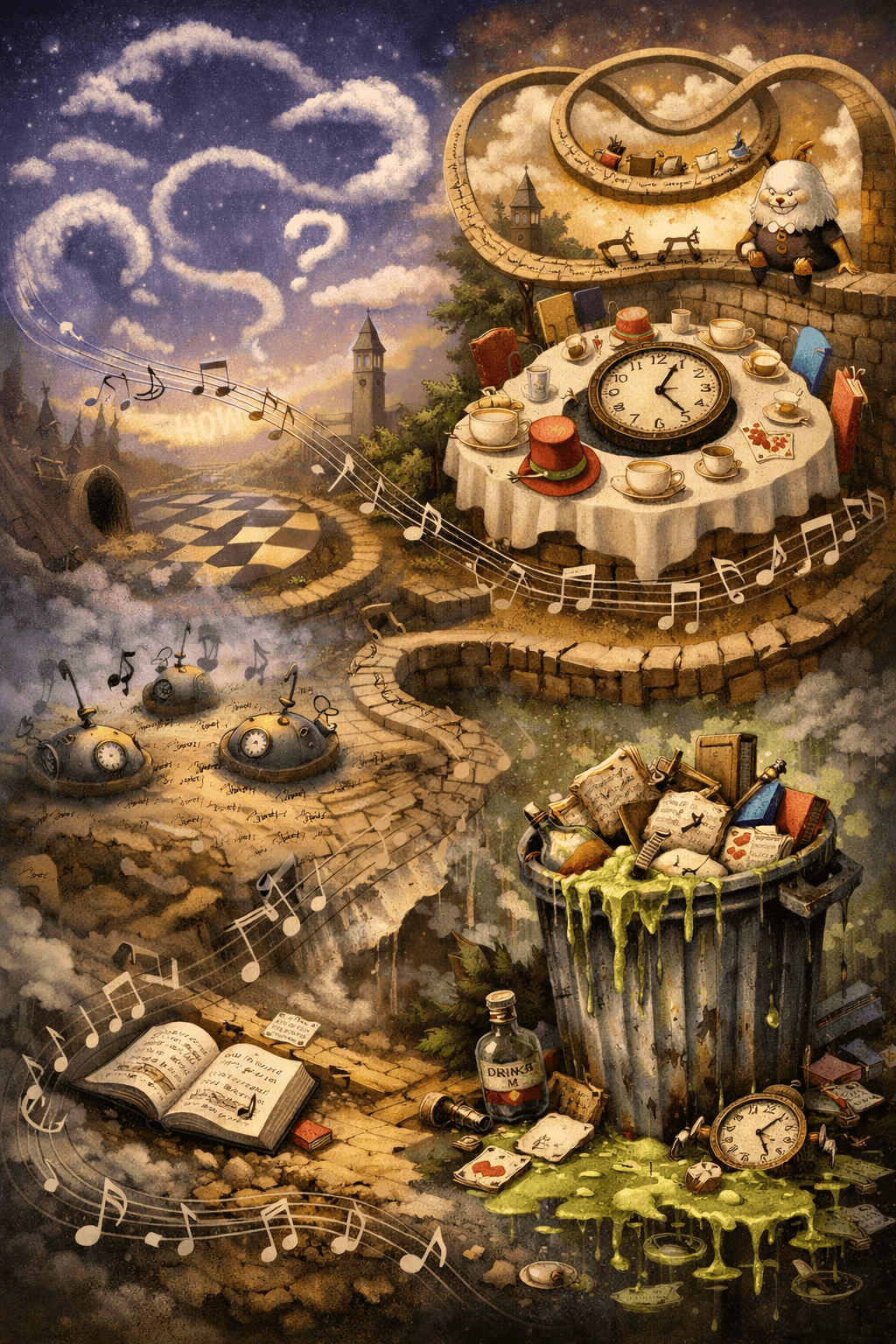
Reacting to my previous post, a philosopher friend asked why people sing at all. In response, I suggested that while there are many theories, it is worth stressing that singing appears to be as universal as language, and the two likely evolved in tandem. In a number of languages - such as Pirahã - there are distinct communicative modes organized around melody and rhythm (for instance, whistled or hummed forms of speech; see, e.g., Don’t Sleep, There Are Snakes: Life and Language in the Amazonian Jungle by Daniel Everett).
But I was a bit baffled by the question. Having worked on song for 17+ years, I have never asked it myself. It also happened to coincide with my reading of The Logic of Sense by Deleuze, with a commentary - and this very straightforward, simply put question projected itself onto a dense and relatively complex text. I would like to stay with this encounter for a while, and also revisit the two Alice books by Lewis Carroll that Deleuze repeatedly references in the book.
In responding to my friend, I also suggested that songs can be understood as ancient parasites inhabiting the mind. What follows, then, is a deliberately discontinuous set of reflections - on parasitism, Gilles Deleuze, Lewis Carroll, and songs - in several parts.
1. Wh-
The question “Why do people sing?” is wrong in that it creates the impression that asking “why” can be separated from asking “what,” “who,” “where,” etc. Happily, English gives us the opportunity for all of these possibilities to coalesce into the unpronounceable “wh-” (with the exception of “how” - but I want to include it, too).
So one question begins to unfold into a depth of questions: who do we sing, what do we sing, where do we sing, how do we sing, and so on. It starts to take on a singable form, one that follows what Roman Jakobson calls the “poetic function” - language organized around form, rather than around meaning.
One consequence is that once there is one question, there are already all the others – in the logic of refrains that produce a call-and-response landscape, where each question calls forth an answer, and each answer generates another question. The practice of inquiry is in itself structured like a song (or a verse).
At this point, an important caveat: I am not, at least for now, distinguishing between singing and versing, or between songs and poems. In line with Jakobson’s account of the poetic function, I am also including proverbs, rhymes, and similar forms of language.
2. The Reset
Much has been said about the pleasures of repetition - from its grounding in biological rhythms and natural cycles to its inscription in cultural forms such as dance, and further to its role in repeated experience within aesthetics. Far less, it seems to me, has been said about the other side of the same operation: repetition as tedious, exhausting, at times almost unbearable.
As a living being, I am sometimes overwhelmed by the repetitiveness of the world I inhabit. There are moments when I would prefer more variation in the events that surround me. What songs seem to make possible is a different relation to repetition in time: they render patterns that might otherwise be tedious into something tolerable, even something one can willingly enter and take pleasure in. One way of putting this is that ancient songs function as acoustic - and corporeal - wrappings for ritual. They bind together forms of repetition that are dull, draining, or imposed with those that are experienced as pleasurable. If one wanted to simplify, one could say that everything is thereby connected to sexuality, but that is not the point I intend to make (I the distribution of pleasurable repetition is much more unevenly distributed along the axes of scale, duration, and intensity than monomanic accounts tend to admit).
Before turning to Alice, something should be said about the figures she encounters and the world she moves through. It is, if you forgive me a degree of generalization, a world structured by routines and rituals, where time not only runs differently from our own, but also seems to permit certain strange resets. The tea party continues indefinitely without resolution; one has the sense that Tweedledum and Tweedledee will replay their quarrel, that Humpty Dumpty will return on top of the wall, and so on.
What Deleuze calls states of affairs are, in this world, no less repeatable than what he calls propositions. One simply returns to the beginning of a given section - in this sense, the world is organized not only as an experience of living, but also as an experience of reading (or perhaps watching - in any case, an aesthetic experience). What this double structure suggests is a kind of pact, by which I come to accept the repetition of my own life, its routines, as something aesthetic, something that opens onto a different relation to risk. Repetition in this form excludes death as a finality - things can always reset.
3. Min(d)fields
Songs are things that cannot help beginning. Living in the presence of songs is a little like living in a minefield: one wrong step, and something is set in motion. In the Humpty Dumpty chapter, Alice experiences exactly this:
“As to poetry, you know,” said Humpty Dumpty, stretching out one of his great hands, “I can repeat poetry as well as other folk, if it comes to that-”
“Oh, it needn’t come to that!” Alice hastily said, hoping to keep him from beginning.
More than once, Alice stumbles into song or verse as into something one accidentally steps on. As the literature on involuntary musical imagery shows, even a minimal cue or passing memory can set a tune running in the mind. The strings that attach songs to minds are extremely sensitive. In this sense, mindfields are like minefields.
The involuntary automaticity that Alice and the other characters so often encounter in relation to song is the automaticity of being drawn into a role. Songs are scripts; in Carroll’s world such scripts do not merely structure speech - they are radically performative. What takes place in a song, takes place in the world, and vice versa. Songs are what this world is primarily mediated through.
This mediation and this reciprocity ground the machinery of reset that mentioned in the previous section. Nothing is final, everything can be replayed. More strongly still, everything has to be replayed, and the tiniest trigger is enough to set the replay in motion. Were songs slightly more stable, they would be indistinguishable from myths. For all practical purposes, they are myths, or perhaps shorthand forms thereof. The song-laden minefield of the mind thus resembles the terrain of ancient tragedy, where characters fall into myths like traps.
4. Garbage Juice
Besides the automated, unwanted, involuntary replay of songs in the mind and in the world, Alice also turns to song as a test of identity: by recalling verses, she checks whether she is still herself (see, e.g., Kathryn Wakely-Mulroney, “Lewis Carroll’s Taxonomy of Reading”). Verses, or songs, are presented here as something deeply bound up with who one is. As Carroll mocks the Victorian educational ideal in which memorized verse was supposed to instill values and shape conduct, Alice’s recitations become a kind of experiment in how such a mechanism might work: in a situation where one no longer knows what to do or who one really is, one chooses to remember a verse.
This is the experiment: let us assume that rote memorization really works. Let us assume that whatever education puts into a person remains there intact, ready to be drawn upon when guidance is suddenly needed. The point is not only to test Victorian pedagogy, but to test a much broader premise that underlies rationalist models of education as such: that what has been ingrained in the mind is precisely what will remain within it, and precisely what one will later retrieve from it. This is a container model of mind. Even if the mind is a minefield, the mines remain distinct from the terrain itself; content is one thing, mind another. Content can be deposited there and later activated or tripped over.
Alice’s experience suggests otherwise. What one finds in the mind is not stored content in any clean or stable sense, but mush, slime, residue - something sticky, distorted, half-spoiled. If one insists on keeping the container metaphor, then it ought to be pictured not as a clean vessel but a dirty bin, with sediment clinging to the bottom. The affect that overwhelms Alive when she reaches inside herself and pulls something out is not the reassuring recovery of an intact possession. It is closer to the feeling of touching something unpleasant in a trash can - something one did not mean to touch, but that has nevertheless remained there to be touched and has been touched.
Songs cling to whatever I take myself to be, if and when I summon enough courage to actually take myself as something. They are bound up with my identity and with my obligation to do what I take myself to be supposed to do, to feel, and to become. I can, naturally, try to recognize myself through this residue, through what has dried onto the inner walls of my mind. But when I come to think of it, the procedure is revolting. I don’t want to identify myself by the taste of my own garbage juice.
This is more radical than the mere “fecality” that Antonin Artaud hurls at Lewis Carroll - the point Deleuze takes up in the Series on the Schizophrenic and the Little Girl in Logic of Sense. Shit still belongs to an economy of incorporation: it comes from what one consented to swallow. Trash residues and garbage juices seep out of a parallel shadow system of rejection, rot, and remainder. It is what drips from what was never assimilated, never redeemed, never even granted the dignity of consumption. The afterlife of refute, not the afterlife of food.