Lucier
Beckett
Sound art
Paper
Echolocation
Resonant Traces: Time, Space, and the Materiality of Sound in Beckett and Lucier
The following is a brief summary of a talk I gave remotely at a conference at Moscow State in May 2025.
This paper brings together two works that at first glance belong to very different artistic territories: Samuel Beckett’s play Krapp’s Last Tape (1958) and Alvin Lucier’s sound piece I Am Sitting in a Room (1969). One comes from late modernist theatre, the other from experimental music and sound art. Yet when we look at them closely, they share a surprisingly similar structure. In both works a human voice interacts with recording technology. In both, repetition plays a crucial role. And in both cases speech gradually shifts away from meaning toward something closer to form.
Both works are built around a very simple material setup. In Beckett’s play, a man listens to old recordings of himself. In Lucier’s piece, a man records himself speaking and repeatedly re-records the playback. These setups are minimal, almost embarrassingly simple. But precisely because they are so simple, they allow us to observe something fundamental: how a voice moving through time or space gradually accumulates traces of the environment through which it travels.
Let me briefly describe the two works.
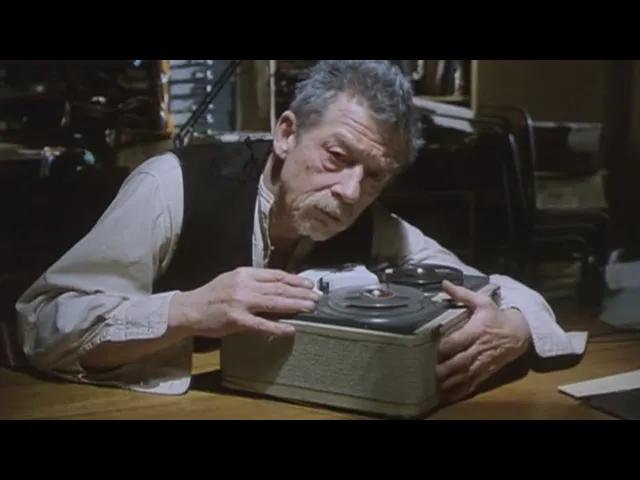
Krapp’s Last Tape (1958) is a one-act play featuring a single character, Krapp. The setting is extremely sparse: a dark room with a table, a chair, a tape recorder, and a box of reels. On his birthday each year, Krapp records a tape reflecting on the past year of his life. Later, he listens to earlier recordings of himself. The play shows him listening to a tape made when he was thirty-nine, reacting to the voice of his younger self, and occasionally stopping or rewinding the tape to comment on it.
The action of the play consists mostly of very simple operations: listening, rewinding, fast-forwarding, commenting aloud. There are also long pauses and small physical routines such as eating bananas, fumbling with the machine, searching through boxes of reels. Beckett slows everything down so that the technology of recording becomes almost as important as the words themselves. The tape recorder is not a prop but the device that structures the entire experience.
Lucier’s I Am Sitting in a Room (1969) is built around an equally minimal situation. Lucier reads a short text aloud describing exactly what he is doing, i.e. recording this text in this room. Then he plays the recording back into the same room and records the playback again. The process repeats over and over.
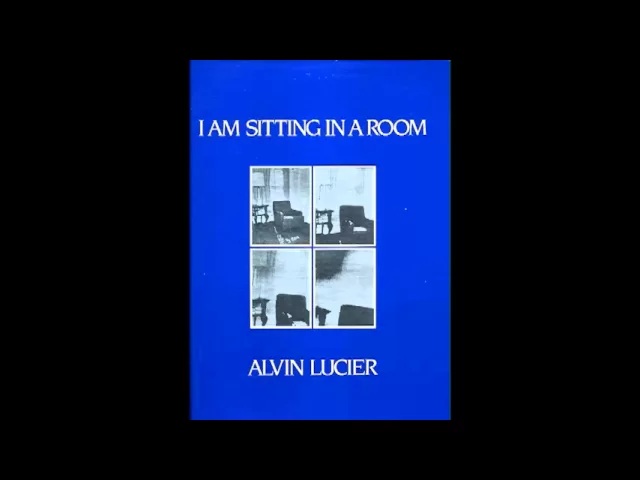
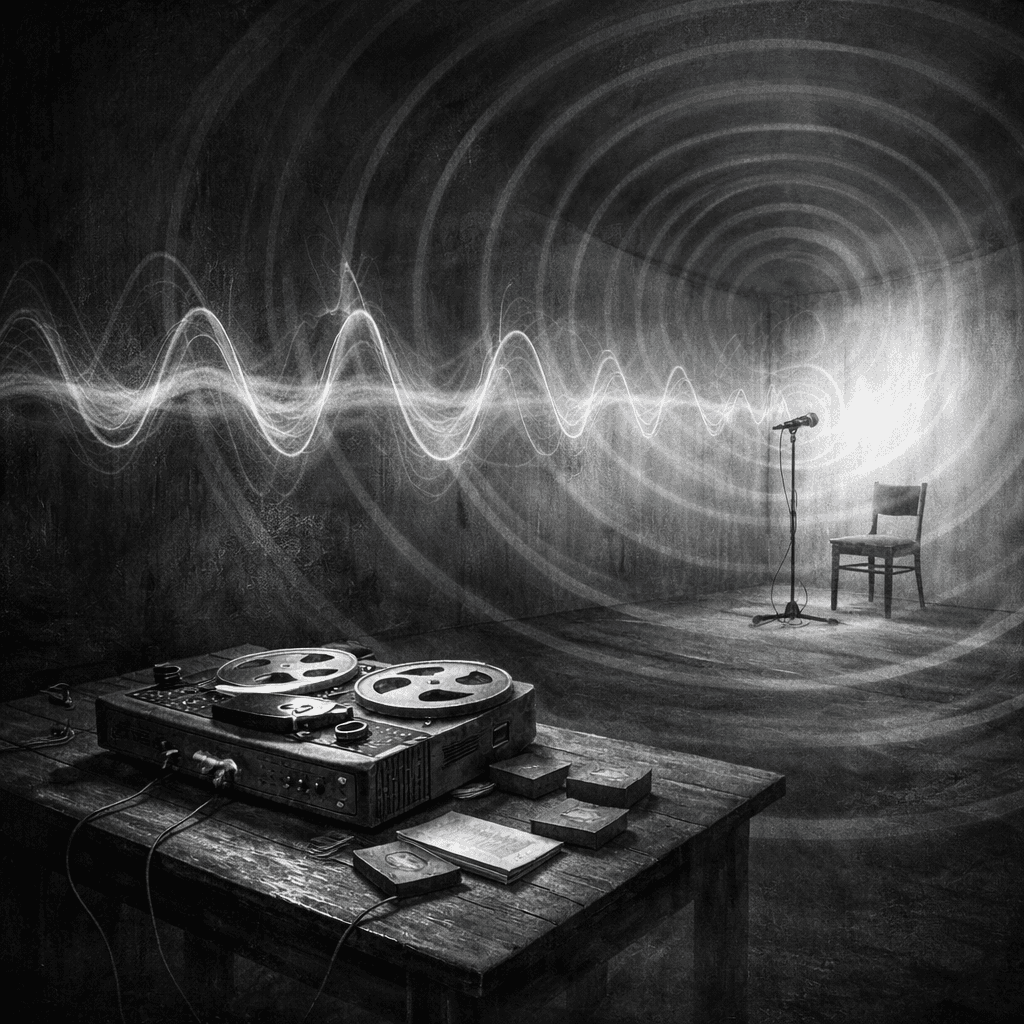
With each cycle, the acoustic properties of the room begin to dominate the sound. Certain frequencies resonate more strongly than others. Gradually the intelligibility of the speech disappears. The words dissolve into sustained tones and harmonic textures. In the end, what we hear is no longer a voice speaking but the resonant structure of the room itself.
The piece begins with the line: “I am sitting in a room.” It is difficult to imagine a more banal statement. It almost sounds like the sort of proposition analytic philosophers like to use when discussing language; a simple description of a state of affairs. But this banality turns out to be extremely useful. Because the sentence carries almost no narrative content, its gradual disappearance does not feel like a loss. The words quietly erase themselves while revealing something else, i.e. is the acoustic form of the room.
The two works share a similar trajectory. They both begin with speech that appears meaningful, even if somewhat banal. But through repetition and technological mediation, speech gradually turns into something closer to sound as such. Language slowly gives way to resonance.
To make sense of this transformation, I want to talk of echolocation.
Echolocation is the biological sonar used by bats to navigate and hunt. Bats emit high-frequency sound waves through their mouth or nose. These sound waves travel through space, bounce off objects, and return as echoes. By analyzing the time delay and frequency changes of these echoes, bats can determine the location, size, shape, and even texture of objects around them.
The crucial point is that the emitted signal itself does not really carry information about the environment. It is more like a probe. In terms borrowed from information theory, we might even say it is “noise.” As the signal travels through space, it accumulates information about the environment it encounters. The returning echo has a shape that has been formed by the environment.
This information is not encoded symbolically. It is embodied in the sound itself. The echo is literally shaped by the environment it has passed through.
Something very similar happens in the works of Lucier and Beckett. The voice functions as a probing signal. As it moves through space or through time, it accumulates traces of the environment. When the signal returns, through playback or through memory, it carries the imprint of that environment.
In Lucier’s piece, the environment is a room. In Beckett’s play, the environment is a lifetime.
The metaphor of echolocation also helps me think about a difference between seeing and hearing. When we think visually, we tend to imagine the world as a collection of objects. Objects have boundaries. They sit inside containers such as rooms. The spaces between objects often disappear from attention.
Hearing, as noted by many colleagues, behaves differently. The “in-between” things – air, reverberation, wind – constantly intrude into the foreground. Anyone who has tried to have a phone call on a windy day knows how quickly noise can overwhelm speech. What we thought was a transparent medium suddenly becomes the most noticeable part of the experience.
Sound often reveals environments rather than things.
Humans can sometimes practice something like echolocation themselves. Some visually impaired people navigate spaces by producing clicking sounds and listening to the returning echoes. But in most cases human echolocation requires technological assistance.
Recording technologies allow the voice to function as a probe in ways that would otherwise be impossible. The human voice emits the signal, and the recording device captures and returns it. The result is what we might call a kind of cyborganic echolocation: a hybrid system combining human vocal production and technical apparatus.
Lucier’s piece is perhaps the clearest demonstration of such a system. Each cycle of recording and playback sends the voice back into the room. The room gradually inscribes itself into the signal. What begins as language ends as resonance.
Listeners therefore witness a progression from meaning to form. At the beginning, the voice carries semantic information. At the end, it carries only the acoustic signature of the room. The voice that once described the room has itself become shaped by it.
This transformation takes time. Lucier’s piece often requires more than twenty iterations before language dissolves completely. The process is slow and patient. But precisely because it is slow, we can hear the gradual emergence of form.
Beckett’s play performs a similar probing operation, but the environment it explores is temporal rather than architectural.
Krapp records a tape every year. Each tape is like a signal sent forward into time. Decades later he listens to these signals again. What he hears are echoes of earlier versions of himself.
These echoes are often strange and uncomfortable. The younger voice sounds overly confident, sometimes pompous, sometimes naive. The older Krapp reacts with irritation or disbelief. The tapes do not provide a stable narrative of a life. Instead they reveal discontinuities between different moments of that life.
The voice of the younger Krapp becomes almost alien to the older one.
Over time the recordings themselves become more important than what they say. The yearly repetition gives the process a clock-like rhythm. Each tape marks another cycle of probing the past.
This is why the title Krapp’s Last Tape is so intriguing. Why the last tape? One possible answer is that the form of the lifetime has finally become visible. Enough repetitions have accumulated. The pattern is already there.
The subject that emerges from this process is not a coherent identity but something closer to an acoustic residue. Krapp appears less as a person with stable contents and more as a kind of echo pattern produced by repeated recordings.
Both Lucier’s and Beckett’s works therefore destabilize the idea of the subject as a container of meanings. Instead the subject appears as something shaped by interactions between voice, technology, and environment.
Where exactly is the subject located in these works? Is it inside the speaking voice? Inside the machine that records and plays it back? Inside the listener who interprets the sounds?
Neither work gives us a definitive answer.
Instead we encounter a strange acoustic overlay of possible subject positions. These positions coexist almost like standing waves in physics; patterns that have form but no stable substance. Under these conditions the subject becomes something that has a shape but not much content.
This shift from content to form is, of course, generally characteristic of modernist art that foregrounds form itself, exposing the procedures through which works are constructed. In some cases this exposure becomes recursive. Once form is foregrounded, the very act of foregrounding becomes another layer of form that can be repeated and manipulated.
In Beckett and Lucier, this modernist emphasis on form is enacted through sound. The voice becomes an instrument for probing environments. Recording technology allows this probing to unfold slowly through repetition.
Both works perform rather than represent resonant traces. They allow us to hear how voices interact with the spaces and times they inhabit.
If echolocation helps bats avoid obstacles and capture prey, it does so by revealing shape and motion rather than content. Something similar may be happening here. To grasp something – whether it is an object, a room, or even a subjectivity – it may be more useful to probe its form than to search for meaning.
In this sense, both works invite us to practice echolocation, in space and in time. My voice is not a carrier of meaning, but a probe that I launch in the hope that it hits something near or far, in the past, or in the future. The resonances that return reveal the shapes I inhabit.