Media
Song
Lecture
Paradox of Choice in Small Content
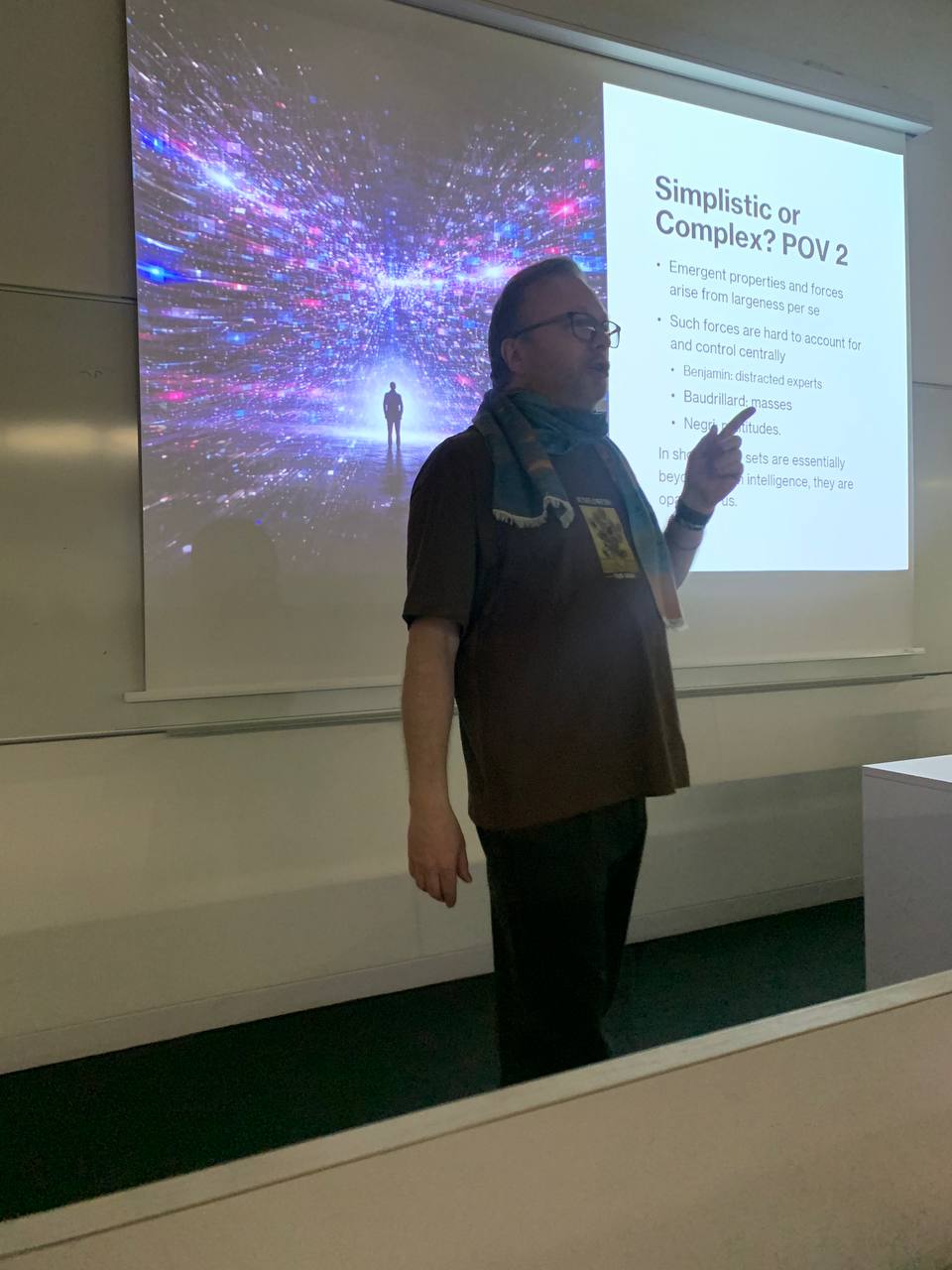
The following is an edited transcript of a lecture read on March 2, 2026 at CUNY, Prague.
Thank you very much. Before I start, I’d like to thank Ondřej Váša for the invitation and to thank all of you for coming tonight.
The topic of my talk is connected to something that happened to me about a month ago. While I was deciding what to speak about, something unpleasant happened – something that happens to scholars all the time. The German scientific giant, the DFG, which funds people like me – the irresponsible crowd – rejected one of my applications. It was a project about short-form content, and I see today’s lecture as a small act of revenge, because you can’t appeal a DFG decision – it’s final, and the only option is to reapply. I will reapply, but with a different project. The core criticism that I received on this one was that my selection of material was “not optimal.” The project was meant to combine short forms – songs, short videos (Reels, YouTube Shorts, TikToks), and some film – and the reviewers felt that this combination was too random to be methodologically convincing.
I’d like to begin with a brief foray into mathematics. I have a minimal STEM background which gives me at least a passing familiarity with how these things work. Has anyone here heard of the axiom of choice? You may have encountered it in popular science – those philosophical or mathematical ideas that circulate beyond specialist circles. The axiom of choice comes from set theory, a peculiar late-nineteenth-century domain of mathematics entangled with paradoxes. You may know the classic example of the barber who shaves everyone who does not shave himself – does he shave himself? Within that same ecosystem of problems, one of the most consequential results is the axiom of choice, formulated by the German mathematician Ernst Zermelo.
Very roughly, it states that given any collection of non-empty sets, it is possible to construct a new set by choosing one element from each set – even if the collection is infinite. On the level of everyday intuition, this sounds harmless. Imagine a row of baskets, each containing something. I take an empty basket and walk along the row, selecting one item from each. I don’t even need to specify a rule for how I choose. The trouble begins when we extend this logic to infinite collections – because then it leads to very strange consequences.
One of these is the possibility of non-constructive proofs. “Non-constructive” means you can prove that something exists without being able to construct it. I can demonstrate that something must exist, but I cannot tell you where it is or how to produce it. It exists – you have to accept that – but you cannot do anything practical with it.
The axiom of choice is also connected to the Banach–Tarski paradox. Alfred Tarski – one of the founders of modern logic and philosophy of language, born in Poland and later working in the United States – and Stefan Banach proved that if you take a solid ball in three-dimensional space, cut it into a finite number of pieces – five suffice – and reassemble them, you can obtain two balls of exactly the same size as the original. In principle, you can continue generating more copies.
How is this possible? Very roughly, if you accept the axiom of choice, you begin with an object of definite volume, then treat it in a way that breaks the ordinary notion of volume – there is a stage at which “volume” becomes indefinite – and finally reassemble the pieces so that definite volume reappears. That is where the paradoxical doubling becomes possible.
At this point you may be wondering why you are listening to me rambling about set theory. Let me circle back. The analogy is, I think, revealing. When we deal with very large quantities – practical infinities rather than mathematical ones – selecting a representative subset with controllable properties becomes extremely difficult. The act of sampling itself becomes problematic and can lead to paradoxes.
Of course, “large” is relative. It depends on how much storage, computational power, and time you have. With weak computers, modest collections are already overwhelming; with powerful ones, you can process genuinely massive corpora. Zermelo originally developed the axiom of choice while working on whether the set of real numbers can be well-ordered. Large collections are easier to handle when they can be ordered in some systematic way.
Today I’m not focusing on pure data but on cultural artifacts: small, compact forms – songs, short videos, lyrical poems, memes, perhaps even prayers. Because they are compact, their production and consumption can be easily pipelined, which accelerates their multiplication. The question, then, is how to deal with these small forms. You might call them artifacts, cultural units, or memes in Richard Dawkins’s sense. For simplicity, I want to sketch two contrasting viewpoints.
The first is associated with the Frankfurt School – Adorno, Horkheimer, and others. According to their view, mass-produced forms are standardized. There may be countless songs, but they ultimately derive from a limited number of prototypes – Ur-forms. The sheer quantity does not matter. Adorno calls this “pseudo-individualization”: products appear different while remaining structurally the same. Think of buying a new iPhone. It cannot be too different from the previous model – otherwise it ceases to be an iPhone – yet it must be different enough to persuade you to upgrade. Pop songs operate similarly: they must be both the same and different, within a culturally acceptable spectrum.
From this perspective, individual songs or videos amount to what I would call a barren combinatorics of repetition – barren in the sense of fruitless, not genuinely generative. Individual examples are not worth studying because they are merely instantiations of patterns. What matters are the patterns, and behind them the forces that produce them. In a Marxist framework, the focus is not on things themselves but on the forces of production. The mass of material may be enormous, but it is treated as essentially simple: reduce it to patterns, and reduce the patterns to underlying forces.
Let me move to the second viewpoint, which is almost the opposite. Here, numbers matter. When you have vast quantities of similar entities, emergent properties arise from largeness itself. Your body contains an enormous number of cells. They derive from the same genome and differentiate, but their sheer quantity is essential. With four cells, or five hundred, or even a million, you would not have something human. The forces that emerge from largeness are difficult to account for and difficult to control.
Let me approach this through two brief examples. First, Walter Benjamin. I place him here rather than with Adorno because he did not share many of Adorno’s assumptions. In The Work of Art in the Age of Mechanical Reproduction, he suggests that in mass culture everyone can claim a kind of expertise. In classical art, expertise requires study and competence; literacy alone is a prerequisite. Only then does one’s voice carry weight. In mass culture, by contrast, we feel entitled to an opinion without special training. That may be one of the clearest definitions of pop culture – not how it is produced, but how it is handled discursively. If you feel entitled to judge it without preparation, it likely belongs to mass culture.
This entitlement implies a certain lack of focus. You can judge while being lazy or distracted – as people do when watching television or YouTube. You are not taking notes – at least, I hope not – yet you pass judgment. The resulting cultural landscape is flat: no stable hierarchies, no universally accepted heights. You may love one series, your neighbor another, and there is no definitive method to objectify those preferences.
Second, Jean Baudrillard. In In the Shadow of the Silent Majorities, he attempts an analytic assault on “the mass.” The masses – people like you and me counted in millions or billions – are opaque and unpredictable. He spends a few hundred pages explaining, in essence, why he cannot really say anything determinate about them. The point is similar: large sets exceed our cognitive grasp. They become opaque.
Now let me combine these views rather than simply oppose them. Massive data sets – or cultural sets – are opaque and unintelligible, and at the same time uninteresting, repetitive, banal. We say the worst of both worlds applies. Yet when we do that, we may be revealing more about ourselves than about the objects.
Several problems arise. Why rely on human judgment at all? Why assume humans – rather than machines or other entities – should determine what is interesting or intelligible? Moreover, large sets do not only contain information. In the case of Baudrillard’s mass, they contain bodies. Bodies interact materially; they exchange affects and energies that are not reducible to information. Finally, against the Frankfurt School: the fact that you can describe something through a scheme does not mean it truly is a scheme. Simplification does not prove simplicity. A model is necessary for thought, but it does not exhaust reality. Otherwise we end up like in Plato’s cave – staring at shadows on a flat surface.
Let me ground this in a story. Evan Eisenberg’s The Recording Angel: Music, Records, and Culture from Aristotle to Zappa begins with a man named Clarence. He owns 500,000 records. He has devoted his life to collecting them. He cannot pay his bills; his house lacks running water; he is physically buried in LPs. Is he a hoarder or a collector? From the outside, it looks like pathological chaos. From the inside, however, he inhabits a well-ordered universe. He knows where every record is and remembers the story behind each one. Many of us feel similarly about our desks – chaotic to others, perfectly ordered to ourselves.
How much music is half a million LPs? Roughly 40 terabytes of MP3s at decent quality. Spotify, by comparison, is in the range of 800+ terabytes. Scale is relative, and materiality matters. You are not literally buried under Spotify. But in another sense you are, because you will never listen to everything available to you.
Glenn McDonald, formerly Spotify’s “data alchemist,” argues in You Haven’t Heard Your Favorite Song Yet that you cannot possibly find your favorite song by exhaustive listening. It is physically impossible. You have to trust Spotify who will take you by the hand and guide you to that favorite song of yours that you’ll never find on your own. If that sounds religious, it probably is.
So how do we dig ourselves out? If you want to write about songs, TikToks, or other small forms that exist in overwhelming numbers, what tools are available? You can rely on ratings and charts – Billboard Hot 100 is practically a disciplinary standard. Popular music is supposed to be popular, so popularity becomes a selection criterion. You can use prizes – Grammys, Emmys – or sales numbers. You can use historical heuristics: focus on songs known to have mattered in a particular social moment. Or you can adopt arbitrary criteria – songs beginning with C, titles longer than three words, artists born in Missouri. Different research questions justify different filters.
But there is another complication. Short forms are not truly units of real experiences; they are designed for repetition. A song is not fully a song if heard only once. Songs demand replay. Your consumption landscape consists not of isolated items but of items repeated in varying patterns. “One hundred hours of music” could mean one song on repeat or a hundred different songs. Every song is ready to fill infinity. The ideal scenario for a track – or a perfect TikTok – would be that you press play once and never stop.
Yet songs compete for attention. Other tracks knock on your cranium: try me. Spotify pulls you by the hand: this is not your favorite yet. The landscape is composed of forces as much as of numbers.
What can I suggest? We may need to abandon the ideal of a “good,” representative selection. This applies beyond media studies – consider political polling. Sometimes most polls are wrong; a few are right, but whether through merit or luck is unclear. The very notion of representativeness may be more fragile than we assume.
If short forms are used to investigate something external – social processes, fashion, historical moments – then criteria should be tailored to that specific inquiry. They are not universal. In that sense, anything goes. When buried like Clarence under masses of content, we might embrace strategic arbitrariness. I can select songs beginning with the letter I. It seems absurd – but no selection is ultimately justified in a final sense. Imposing the letter I is a kind of symbolic violence, but any filter would be.
We might also relax the centrality of the human perspective. Friedrich Kittler approaches culture from a post-humanist angle: perhaps humans are only an intermediary stage before machines perform the primary operations. We need not treat the human viewpoint as definitive. Nor should we assume culture is vertically ordered with stable hierarchies. What we face is a horizontal landscape.
Practically, in my field – songs – you can take any single song and imagine a world in which it is the only song. What rules does it establish? If only two songs existed, how would their competition unfold? The same thought experiment applies to any form of short content.
I am not trying to indoctrinate you into madness. I would like you to feel more playful – and perhaps slightly more irresponsible – when confronting small forms that threaten to bury us in their numbers. That is what I wanted to share tonight. Thank you very much.