Review
Music
Angine de poitrine
Dizzy and (Un)convinced: Angine de Poitrine

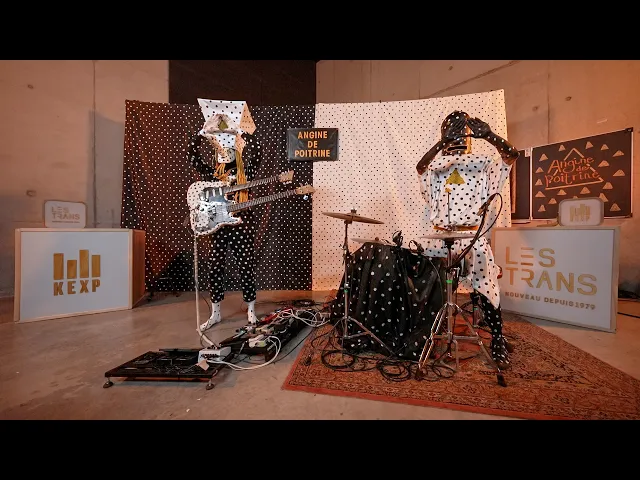
For the past weeks, the musical internet has been animated around Angine de Poitrine, a little-known (until recently) band from Quebec who play a kind of microtonal, loop-driven funk while wearing costumes and maintaining anonymity. The debates were sparked by their live session on KEXP:
When I first came across them and watched a few clips on YouTube, I felt a certain obligation to react. I spend a good deal of time with music that is labeled “avant-garde,” “strange,” or “complex,” and it seems many online listeners with comparable habits experienced the same impulse - and chose to articulate it.
What repeatedly surfaced in these responses is that the music does not register as atonal. Although AdP work with a 24-note scale, the material remains relatively easy to parse: the harmonies and melodies retain a sense of internal coherence. Listeners also noted the techniques that sustain this effect. The band frequently relies on chromatic motion, with adjacent pitches unfolding in sequence, so that quarter-tone differences do not come across as distortions of familiar tones. They tend to favor conventional intervals rather than ones expanded by quarter-tones. At the same time, the rhythm - while occasionally intricate - remains tightly controlled, often driven forward by a relatively fast tempo.
All of this produces a sound that comes across as “tight,” “edgy,” and “anxiously happy”; it is also notably clean - something that, for me, perhaps recalls the more experimental varieties of new wave from the 1970s/80s. On the other hand, the fact that they dress up and speak (or sing) in an “alien” language brings to mind Gong, Magma, Sun Ra, GWAR, and Acid Mothers Temple, along with many lesser eccentrics I remain very fond of - with Magma occupying a particularly central place for me.
I have always felt that the primary force of these “freakish” “otherworldly” projects resides in the long form. I doubt I would ever have listened to lighter Merci-era Magma had it not been for Mëkanïk Dëstruktïẁ Kömmandöh. This is music you have to let unfold, repeat, and gradually spread itself out before you; the first encounter only grazes the surface. It demands repetition after repetition: recurring passages, recurring constellations of passages, recurring tracks, and my own repeated returns to them. There was something fractal to how I remember approaching Magma - or, perhaps, to how it seemed to force that approach on me.
AdP is likewise repetitive at its core - not least because the guitarist/bassist’s primary instrument is effectively neither the guitar nor the bass, but the looper. But they do not work in long forms - at least not yet. So it remains unclear whether I can really claim to know this music, or even whether I like it. For all the “tightness” of the frame, the microtones do leave me somewhat dizzy - partly because they occasionally register as slightly “off” versions of familiar notes, and partly because the chromatic progressions produce vaguely “Oriental” inflections that have a similar effect on me. Frankly, there is not enough material to determine whether this dizziness is transient, cumulative, or stable. To test whether I ever get seasick, I need longer trips.
This is not to say that the music is uninteresting or banal; quite the opposite. But I need more of it to relate to it one way or another. The recently released second album is not enough.